Quietly connected.
Thoughtfully integrated.
A smart home begins long before the devices are installed.
Smart Home & Automation
A smart home begins long before the devices are installed.
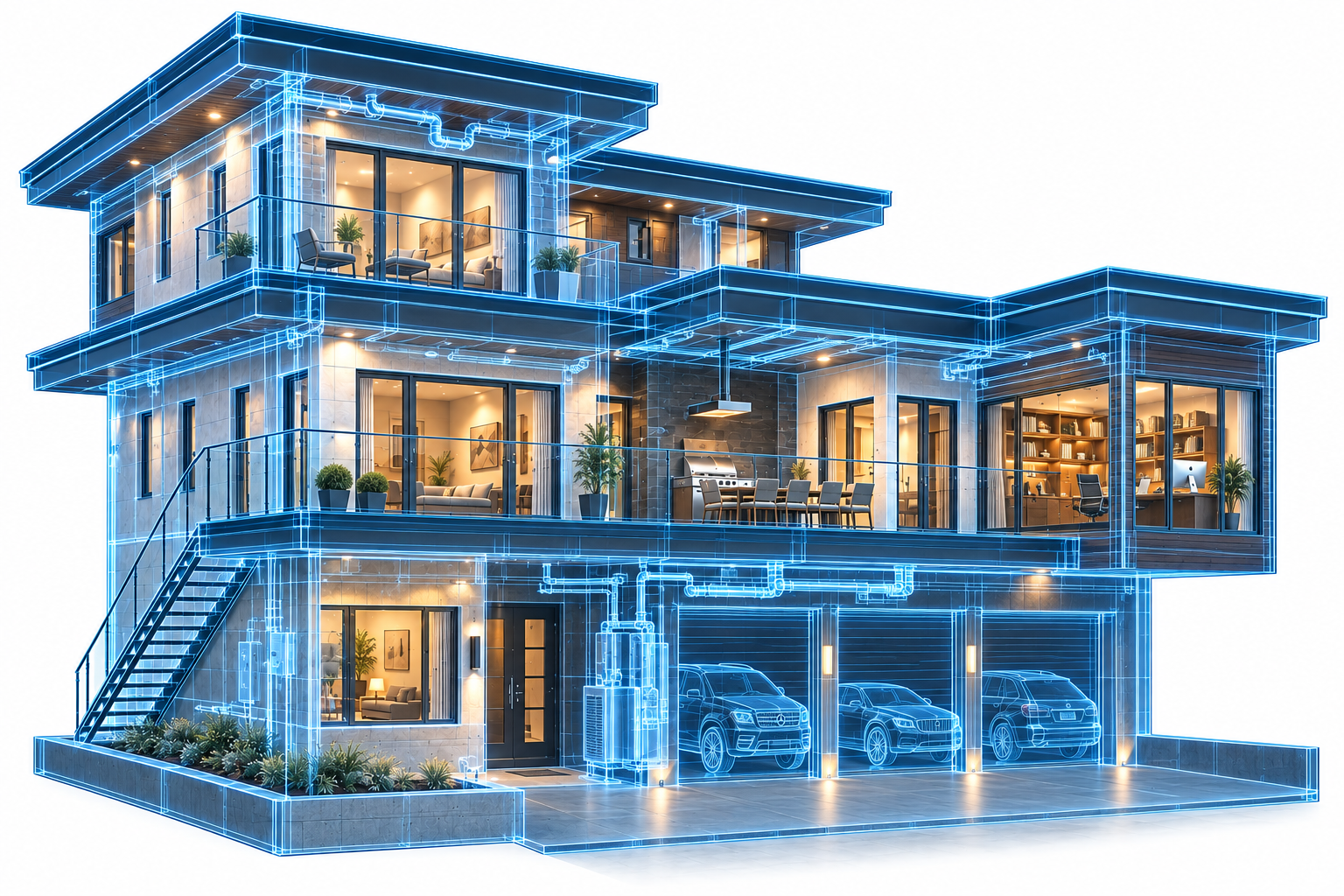
Holistic Homes plans for smart-home and automation technologies as part of the overall design and construction process. This allows electrical, low-voltage, networking, lighting, climate, security, entertainment, and other connected systems to be considered together rather than independently.
Depending on the needs and preferences of each homeowner, a Holistic Home may incorporate technologies for:
- Intelligent lighting and lighting control
- Automated shades and window treatments
- Smart thermostats and climate control
- Connected door locks and access control
- Garage and gate automation
- Smart appliances and connected devices
- Voice and app-based controls
- Environmental and occupancy sensors
- Integrated home-control systems
Technology changes quickly. Our goal is therefore not simply to build around today’s devices, but to create an infrastructure that gives homeowners greater flexibility to adopt new technologies as their needs—and the connected-home ecosystem—continue to evolve.
Connected Entertainment & Networking
Modern homes depend on their networks. Streaming entertainment, smart televisions, whole-home audio, security cameras, automation systems, connected appliances, remote work, gaming, cloud services, and everyday mobile devices can place significant demands on residential connectivity.
Holistic Homes considers this digital infrastructure during construction, when wiring, equipment locations, access points, and future expansion can be planned far more effectively.
- High-performance wired and wireless networks
- Structured low-voltage cabling
- Strategically positioned wireless access points
- Whole-home Wi-Fi coverage
- High-speed internet infrastructure
- Distributed and whole-home audio
- Home theater and media systems
- Streaming and connected entertainment
- Dedicated technology and equipment locations
- Infrastructure for future connectivity requirements
Homes can be designed to accommodate: By considering networking and entertainment infrastructure before the walls are closed, we can help create cleaner installations, stronger connectivity, and greater flexibility for future upgrades.
Security & Monitoring
Technology can also make a home more secure, observable, and responsive.
Holistic Homes can incorporate the infrastructure required for modern residential security and monitoring systems as part of the home’s overall technology plan.
Depending on the project, this can include:
- Alarm and intrusion-detection systems
- Security cameras and video surveillance
- Video doorbells and intercoms
- Smart locks and access control
- Garage and gate monitoring
- Smoke and carbon-monoxide detection
- Water and leak detection
- Environmental sensors
- Remote monitoring and notifications
Planning these systems during design and construction allows cameras, sensors, wiring, power, networking, and equipment locations to be integrated more discreetly and effectively into the architecture of the home.
Energy, Climate & Environmental Technology
Some of the most important technology in a home is technology homeowners rarely see.
Heating and cooling, insulation, air quality, water systems, energy management, and the building envelope have an enormous influence on comfort, operating efficiency, and long-term performance.
For homes in Atlanta and throughout the Southeast, these considerations are particularly important because buildings must perform in an environment characterized by heat, humidity, significant cooling demands, storms, and changing weather conditions.
Holistic Homes evaluates technologies and building solutions that can contribute to a more comfortable, efficient, and resilient residence, including:
- High-efficiency HVAC systems
- Smart thermostats and zoned climate control
- High-performance insulation
- Advanced air-sealing and building-envelope strategies
- Indoor air-quality technologies
- Humidity and moisture management
- Whole-home water filtration
- Water monitoring and leak detection
- High-efficiency fixtures and appliances
- Energy monitoring and management
- Infrastructure for renewable energy and energy-storage technologies when appropriate
Our objective is not technology for technology’s sake. We look for systems and materials that can provide meaningful improvements in comfort, efficiency, durability, environmental performance, and the homeowner experience.
Future-Ready Infrastructure
No one can predict exactly how people will interact with their homes ten or twenty years from now.
What we can do is build with change in mind.
Holistic Homes considers the underlying infrastructure that makes future technology easier to adopt. That includes electrical capacity, structured wiring, networking, low-voltage pathways, equipment spaces, accessibility, and construction methods that can reduce unnecessary limitations when systems are upgraded or replaced.
We also evaluate advancements in construction materials and building technology—from high-quality wood and engineered framing products to steel and other structural solutions, modern insulation systems, electrical components, mechanical systems, and emerging building materials.
Where appropriate for the project, we incorporate materials and construction methods selected to improve durability, efficiency, resilience, and long-term adaptability.
A future-ready home is not a home filled with gadgets. It is a home designed so that its fundamental systems do not unnecessarily restrict what comes next.
Technology for Every Stage of Life
Innovation should also make homes easier to live in over time.
For clients interested in aging in place, Holistic Homes can incorporate technology alongside thoughtful architectural planning to help a residence adapt to changing needs without sacrificing the aesthetics of a custom home.
This may include accessible lighting and environmental controls, step-free access, wider circulation areas, adaptable bathrooms, accessible primary suites, and infrastructure that can support additional technologies in the future.
By considering these requirements during initial design and construction, accessibility can become an integrated part of the home’s architecture rather than an obvious modification made years later.
Where Construction and Technology Meet
The boundary between the construction industry and the consumer technology industry continues to evolve.
Today’s home can include dozens of connected technologies from televisions, speakers, appliances, cameras, sensors, locks, thermostats, lighting controls, and automated shades to sophisticated networking, security, energy-management, and environmental systems.
For a custom home builder, understanding these technologies increasingly means understanding how the home itself must be designed to support them.
That is where Holistic Homes operates: bringing together custom residential construction with the rapidly evolving technologies that are changing how people experience their homes.
We continually explore developments in smart-home technology, home automation, networking, audio and video, security, energy management, environmental controls, building technology, and connected living to understand how meaningful innovations can be incorporated into the homes we build.